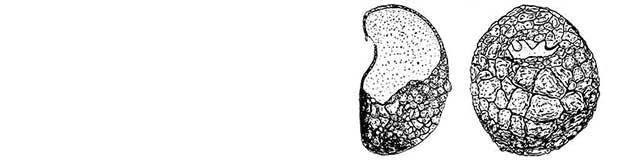
Plagiopyxis glyphostoma Bonnet, 1959
Diagnosis: Shell light beige, quite opaque, slightly elliptical in shape in dorsal view. Pseudostome clearly visible, not very extensive, without cryptostome, and characterized by the presence, on its dorsal lip only, of strong, amorphous, greyish, siliceous teeth, strongly projecting, contrasting clearly with the beige color of the test. In most individuals, the teeth are three in number, the two lateral rounded, the median acute in the form of an isosceles triangle. In lateral view and in optical cross-section, the ventral surface, after having followed a straight line, bends quite abruptly, forming a bowl ending 6 to 10 µm above the dorsal lip. Covering made up, on the ventral face, of irregular siliceous plates, welded by a brownish cement exuding at the connections. On the dorsal side, the platelets are very small and the appearance appears chagrined.
Dimensions: Length 65-72 µm; width 63-66 µm; dorso-ventral (height) 38-48 µm.
Ecology: Soil. Rhizosphere of grasses on granite arena near the Forges of El Mitg (Pyrénées-Orientales).
Remarks: This species recalls, in several respects, Plagiopyxis penardi Thomas, but it differs from it by the shape of the pseudostome and the presence of teeth.