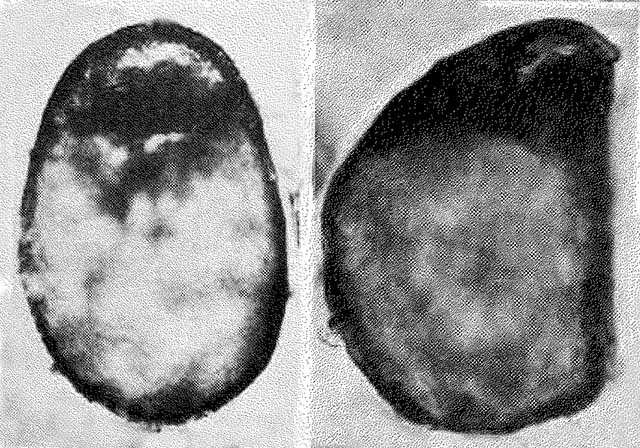
Plagiopyxis longicallida Bonnet, 1984
Diagnosis: Shell strongly elongated in the antero-posterior direction; cryptostome type with visor, much more open than that of Plagiopyxis callida. Color ranging from dark yellow to light brown. In dorsal view elliptical, with a clear constriction at the level of the junction between vestibule and ventral side which is marked by a very clear suture line. In ventral view, a large sole with limits forming part of a yaws, slightly concave, and slightly sloping towards the vestibular aperture. Opening of the semicircular vestibule, clearly visible. In lateral view, the test is remarkable for its height almost equal to the width. Due to the high position of the center of gravity, about 1/3 of the individuals lie on their side in the preparations, a proportion much higher than that observed in the other species of the callida group. Well-marked constriction at the vestibule suture level, giving the visor seen in optical section a characteristic “beak” appearance. Rounded aboral end. Pseudostome elliptical or semi-elliptical, located on the partition separating the ventral region from the visor, near the dorsal wall of the test.
Dimensions: Length 80-108 µm (average 93 µm).
Ecology: Soil. Rare species observed exclusively in calcimorphic soils: rendzines (of lawn or deciduous forest) and skeletal soils rich in decalcification clay (example: soils on lapiaz). France (Languedoc, Causses, Corbières, Pyrenees), Spain (Asturias).
Remarks: The architecture of the test, very close to that of P. callida, differs however by a very weak cryptostomy. It is intermediate between the peaked plagiostoma and peaked cryptostoma types.